How to Price Complex Services with Dynamic Quote Rules
When the price depends on area, hours, rooms, guests or an answer, a single fixed amount cannot be right. These are the four rule types that price complex work live — and the order that keeps the total defensible.
Every service business reaches the same wall. The price list worked while the offer was simple: one haircut, one consultation, one standard visit. Then a customer asks for the same service on a roof that is twice the size, on a third floor without a lift, every fortnight instead of once a month — and the list has no answer.
The usual response is to hide the number and promise a callback. That converts the form into an email, the visitor into a lead, and the pricing decision into a phone call that may never happen. The alternative is a set of rules the form can apply itself, so the visitor sees a defensible number before they commit.
Why a fixed price list fails on complex work
The cost driver is outside your control
Area, hours, rooms, guests, distance and access are facts about the job, not about your price list. A single "from" price either scares away small jobs or loses money on large ones. The only honest answer is to ask for the driver and multiply.
The drivers interact
A weekly clean of a large house is not the price of a one-off clean of a large house times four. Frequency changes the per-visit cost, the schedule and the discount. Pricing the two answers independently produces a total that is wrong in both directions.
The visitor cannot self-qualify
Without a number, the visitor does not know whether the job is in their budget. They either leave or book a call they were never going to keep. A priced form lets them decide in the moment, which is the only moment they are on your page.
The four rule types
Almost every complex quote is built from four operations. Learn them once and the form for a new service is a question of mapping answers to rules, not inventing a pricing model.
Per unit — multiply by a measurable quantity
Use when the cost is proportional to something countable: square metres, kilometres, rooms, guests, teeth, pages.
Example 120 m² of asphalt shingles at 45 per m² = 5,400.
Failure mode mixing units. A rate per square metre applied to a count of rooms is the most common silent pricing bug in self-built forms.
Percentage — adjust for difficulty or commitment
Use when the job is harder or easier per unit: steep pitch, awkward access, weekend work, regular frequency. The percentage expresses what changes the effort, not what changes the quantity.
Example a steep roof multiplier of × 1.25 turns 5,400 into 6,750; a weekly cleaning discount of −20% turns 245 into 196.
Failure mode percentages of percentages. Decide once whether the multiplier applies to the subtotal before discounts, and never chain a discount on top of another discount by accident.
Flat fee — price a fixed amount of work or risk
Use when the item costs the same regardless of size: an emergency inspection, an oven clean, piano handling, a call-out.
Example +180 for packing materials, +140 per skylight, +75 for a next-day inspection.
Failure mode flat fees that should be per unit. A flat "skylight" fee for a roof with six of them is a discount you did not intend to give.
Conditional — change the question, not just the price
Use when one answer makes another question irrelevant or makes a different cost apply.
Example when the roof is flat, hide the pitch question and show the membrane system instead; when both addresses have a lift, remove the floor fee entirely.
Failure mode rules that fire in the wrong order, or a hidden question whose answer still counts in the total. Always test by switching the trigger answer on and off.
Order, rounding and the subtotal
The rule types are simple. What makes a total defensible is the order they run in and which subtotal each percentage uses. Write the order down before you build, because the form will apply it silently on every submission.
-
1
Base and per-unit lines first. These build the subtotal the customer recognises: the visit, the area, the rooms, the distance.
-
2
Difficulty multipliers next. Pitch, access and urgency raise the price of the work, so they apply to the work subtotal — before any discount.
-
3
Flat add-ons after that. An oven clean, a piano or an inspection fee is a separate piece of work; it should not be multiplied by the pitch of a roof.
-
4
Discounts last, on the base they were designed for. A frequency discount applies to the recurring visit, not to one-off extras. If it applies to everything, say so in the option label.
Round once, at the end
Rounding after every step makes a total that cannot be reconstructed from the lines the customer sees. Keep full precision while the rules run and round only the final figure — and use the same rounding on the confirmation, the invoice and the deposit, so the three never disagree by a cent.
The deposit follows the same rule as the total: it is a percentage or a fixed amount of the final figure, not of an intermediate subtotal. If the quote is a range, take the deposit on the lower bound and confirm the balance after the survey. The hand-off from quote to deposit is covered in the quote-to-booking guide.
Worked examples by niche
The same four rules price a roof, a dental appointment and a wedding. What changes is which driver is countable and which adjustments are real.
Trades — roofing
120 m² of clay tile at 90 per m² is 10,800. A 36–45° pitch multiplies by 1.25 → 13,500. Removing the old covering adds 18 per m² → 2,160. Two skylights at 140 each → 280. The estimate is 15,940, shown as a ±10% range until the survey confirms the area.
Open the roofing templateClinics — a dental consultation
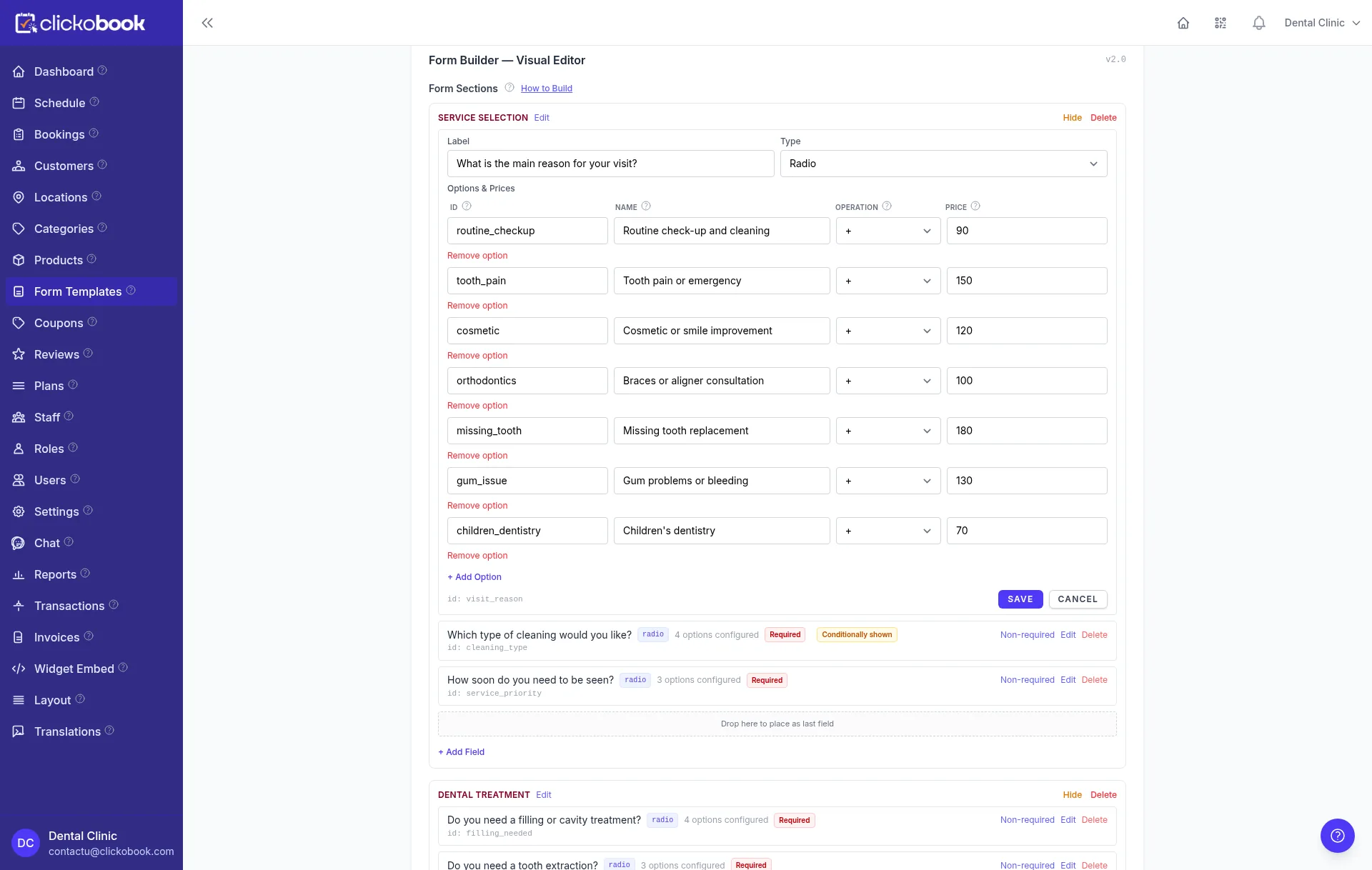
A base consultation of 95 includes the examination and X-rays. Each additional treatment area adds a flat fee; a same-day emergency slot adds a percentage; a follow-up visit is free within 14 days because the condition rule hides the base fee when the patient already attended in that window.
See the dental booking workflowEvents — a private dinner
45 guests at 38 per head is 1,710. Saturday evening adds 15%; a set menu with two choices adds 6 per guest; staff beyond the included two costs a flat 120 each. A guest count above 80 triggers a conditional note that the venue needs a coordinator — not a bigger multiplier.
See the events booking workflowReady-to-rebuild field lists and rule tables for three of these models live in the quote form template library.
Four mistakes that make a priced form untrustworthy
Pricing every option
A price on a purely informational question teaches the visitor to distrust the total, because they cannot tell which answers actually cost money. Price the options that change the work; leave the rest free.
Chaining percentages
A ×1.25 pitch multiplier followed by a −20% frequency discount is not "20% off the base". Decide the base, document it, and test one case by hand.
Surprises after the quote
If removal, disposal, materials or call-out are extra, they belong in the form. A quote that grows on the invoice is the reason customers ask for a PDF and an approval step.
Pretending an estimate is a fixed price
When the measurement is approximate, say so and show a range. The number is still useful; the false precision is what damages trust when the survey disagrees.
Before you publish the form
- Every question changes the price, the visit or the crew — or it is not on the form.
- Each option has the right operation: per unit for quantities, percentage for difficulty, flat for fixed work.
- The rule order is written down, and every percentage has a named subtotal.
- Discounts apply to the base they were designed for, not to extras by accident.
- One total was calculated by hand and matches the form exactly.
- A large or unusual job switches from an estimate to a survey instead of guessing.
If the form is still only collecting facts and promising a price later, start with how a quote form prices the job.
Frequently asked questions
See these rules inside real booking pages
Each industry page shows the same pricing model applied to a specific service.
Price the next job before the phone rings
Build the form, attach the rules and let the visitor see the number — then book the slot and take the deposit in the same flow.