Accounting Quote Form Template — Price Bookkeeping, Payroll and Year-End
A monthly bookkeeping base plus per-employee payroll, quarterly VAT and a year-end fee, with a catch-up charge when the records are behind.
Overview
Accounting enquiries arrive with the same three facts: what the business is, how big it is and how messy the books are. The fee depends on all three, and the last one is the one clients under-report — until they are asked directly.
This template quotes a monthly bookkeeping fee, adds payroll per employee and VAT per quarter, and prices the year-end work separately. The catch-up question is deliberately blunt, because a client two years behind is a different job from a tidy one.
Best for
Accountants and bookkeeping practices that quote a fixed monthly fee plus annual work, and that need to know how far behind the client's records are before naming a price.
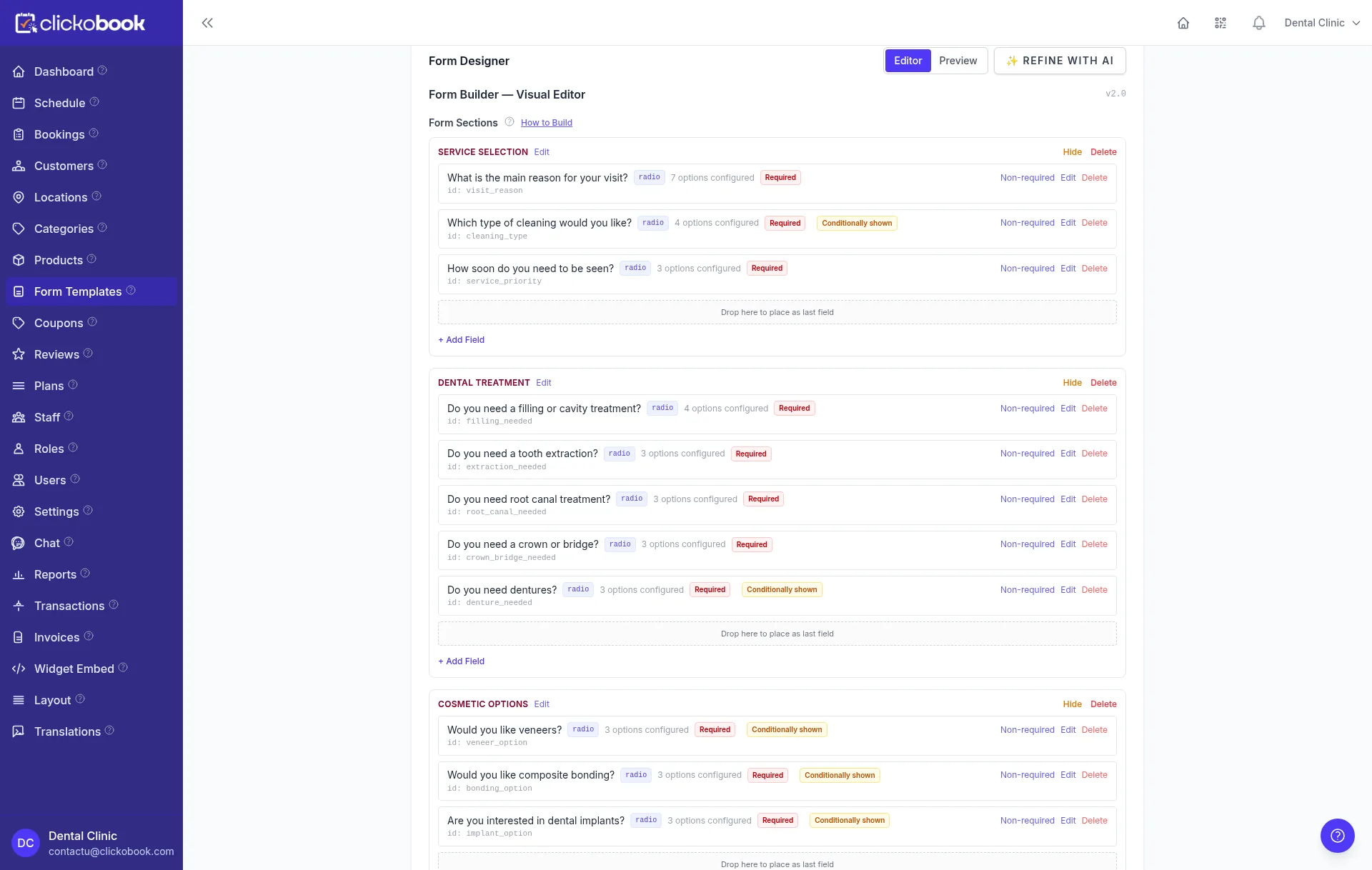
The field list
Every question below earns its place: it changes the price, the visit or the crew. If a question does none of the three, leave it out.
| Field | Type | Why it is asked |
|---|---|---|
| Client type | Select (single) | Sole trader, limited company, partnership or landlord. The filing obligations and the fee structure both follow from it. |
| Turnover band | Select (single) | Turnover drives volume, not complexity, but it is the fastest way to size the bookkeeping work. |
| Accounting package | Select (single) | Bookkeeping only, bookkeeping plus payroll, or a full service. The package decides which follow-up questions apply. |
| Number of employees | Number | Payroll is priced per employee per month, so the count is a direct multiplier. |
| Number of bank accounts | Number | Every extra account is a separate reconciliation. Two feeds are not twice the work, but they are more than one. |
| Current bookkeeping status | Select (single) | Up to date, a few months behind or not started. This is the single biggest driver of the first invoice. |
| VAT registered? | Yes / No | A VAT return is a recurring quarterly task with its own fee, and it is not included in plain bookkeeping. |
| Payroll needed? | Yes / No | Separates a bookkeeping client from a payroll client before the employee count is asked. |
| Year-end month | Select (single) | Year-end work is seasonal and priced once. Knowing the month lets you plan capacity and quote the annual fee. |
| Prior accountant? | Yes / No | A handover needs records, a professional clearance letter and time. It is a one-off job, not a monthly line. |
| Documents ready? | Yes / No | A client with organised records can be quoted instantly; one without them needs a discovery call. |
| Preferred meeting | Select (single) | In person, video or phone. The first meeting has a real cost and some clients expect it to be free. |
Price rules
Each row is one option in the builder with the operation attached to it. The example column is the arithmetic you should see in the live total; use it to check your own configuration before publishing.
| Option | Rule | Worked example |
|---|---|---|
| Self-assessment return | +250 | 250 |
| Annual accounts (limited company) | +850 | 850 |
| Monthly bookkeeping | +120 per month | 12 months × 120 = 1,440 |
| Payroll | +6 per employee per month | 4 employees × 6 × 12 = 288 |
| VAT returns | +65 per quarter | 4 quarters × 65 = 260 |
| Behind on bookkeeping | +15% | 120 × 0.15 = 18 per month |
| Catch-up work | +90 per month behind | 6 months × 90 = 540 |
| Multiple bank accounts | +15 per extra account | 2 extra accounts × 15 = 30 per month |
| Landlord portfolio (up to three properties) | +180 | 180 |
| Company formation add-on | +150 | 150 |
| Annual review meeting | +95 | 95 |
| Out-of-hours meeting | +40 | 40 |
The amounts are illustrative, not a price list. Replace them with your own cost base and currency before publishing — and keep the order of the rules, because a percentage applied to the wrong subtotal changes every total downstream.
Conditional logic
Conditional rules keep the form short without losing the information. Add them in the order below and test each trigger before you publish.
If Client type is Sole trader
Then Hide the annual accounts (limited company) line and show the self-assessment return instead.
If VAT registered is Yes
Then Show the quarterly VAT return fee and add it to the monthly equivalent.
If Current bookkeeping status is Behind or Not started
Then Require the months-behind question and apply the catch-up fee before the first monthly invoice.
If Payroll needed is No
Then Hide the employee count. Payroll is the only part of the quote that depends on it.
If Documents ready is No
Then Replace the instant estimate with "book a discovery call". An unquoted job cannot be priced from a form alone.
If Turnover band is the top band
Then Replace the total with "book a call to scope this". Large books need an engagement letter, not a formula.
Rebuild it in Clickobook
This is the build order we use. It ends with two test submissions, because a priced form is only correct when a total you calculated by hand matches the one on screen.
-
1
Create a "Your business" section with client type, turnover band and accounting package. The package answer decides which later sections appear.
-
2
Add the recurring work as monthly lines: bookkeeping, payroll per employee and bank accounts. Show the monthly fee and the annual equivalent, because clients compare both.
-
3
Add the annual work as one-off lines: self-assessment or annual accounts, company formation and the year-end review meeting.
-
4
Add the catch-up questions — current bookkeeping status and months behind — with the percentage and the per-month fee. This is the line that protects you from an underpriced first year.
-
5
Add the conditional rules in order and test three clients: a tidy sole trader, a limited company with four employees and a client two years behind.
-
6
Connect the discovery-call option to a real slot so a client who cannot be quoted instantly still books a time.
Three things that make this template convert
Show the annual total next to the monthly fee. Clients budget yearly even when they pay monthly, and the annual number is what they compare.
Ask about the prior accountant before quoting. The handover is often more work than the first month of bookkeeping.
Keep the catch-up fee visible. Hiding it until the onboarding call is how a fixed monthly fee becomes a loss.
Other quote form templates
Roofing quote form
Area × material rate, adjusted by pitch and access, with removal and roof features priced per unit. Best when the final number depends on measurements the homeowner already knows.
Cleaning quote form
A base visit price built from rooms and bathrooms, then a frequency discount that turns a one-off quote into a recurring booking. Best for domestic and small-office cleaners.
Moving quote form
A transport base plus distance, rooms and floor access, with packing and large items priced on top. Best for local movers who need a credible range before a survey.
Landscaping quote form
Area × surface rate, adjusted by clearance and scope, with irrigation and waste priced as real line items. Best when the garden size is known but the design is not.
Auto detailing quote form
A package price multiplied by vehicle size and condition, with add-ons and a mobile call-out fee. Best for studios and mobile detailers who need the bay reserved for the right number of hours.
Wedding photography quote form
A core coverage price plus hourly extensions, then second shooter, album and travel. Best when couples compare three photographers on the same evening and need a number they can trust.
Catering quote form
A per-guest menu price plus the service style, then staff, equipment and travel. Best when an organiser is comparing three caterers for one date and needs a total they can put in a budget.
Med spa quote form
A treatment price plus area, package and preparation fees, with a screening step that routes unsuitable enquiries to a consultation instead of a checkout.
Tattoo quote form
A session-length price plus size, placement, style and colour, with a deposit taken at quote time and a cover-up branch that requires photos before pricing.
Browse the full template library, read how quote forms price the job and book it, study the quote rules behind a complex price, or check what a plan costs.
Related guides
Start from this template
Create the form, add your own rates and publish it on your booking page — then take the deposit when the visitor books the slot.